
If you think that revenue officials are going berserk, acting on their own, while the government chants the mantra of 'ease of doing business', you would be wrong. These moves appear to have full official backing, points out Debashis Basu.

'Perhaps GST was too complex a system for the Indian economy at its present stage of development,' argues T N Ninan.
Any judgement on whether the March numbers reflect sustainable growth in GST collection should ideally await the numbers that will be out in May, points out A K Bhattacharya.
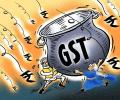
India's GST collection remained above Rs 1 lakh crore for the third month in a row at over Rs 1.17 lakh crore in September, raising expectations that second half of the year will post higher revenues. The tax collections in September on goods sold and services rendered was 23 per cent higher than Rs 95,480 crore collected in September 2020, and 27 per cent higher than Rs 91,916 crore collected in September 2019. The collection in September is the highest in five months since April, when revenue was at record high of Rs 1.41 lakh crore.

The sentence could go up to three years if the evasion exceeds Rs 50 lakh (5 million).

'Efforts to roll out GST from next fiscal'
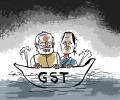
If the items and services such selected subsequently pass the test from the fitment committee and the GST Council, this would be the first of such rate hikes, after a series of cuts in the process of rate rationalisation that started in November 2017.
The Centre is looking to convene a meeting of the all-powerful Goods and Service Tax Council in early January. The meeting is likely to focus on rectifying the inverted duty structure for a few more items and will also serve as a platform for pre-Budget discussions between Union Finance Minister Nirmala Sitharaman and state finance ministers, Business Standard has learnt. "The current Winter Session of Parliament ends on December 23, followed by the Christmas-New Year period. "After that we would like to have a meeting of the GST Council, depending on whether there can be a quorum," a top government official said.

A government report revealed that fake companies floated with fake addresses, issued fake GST invoices and generated fake e-way bills, with fake vehicle registration details without supplying any goods causing huge loss to the exchequer.

GST collections in March touched a record high of over Rs 1.23 lakh crore, a 27 per cent growth over the year-ago period, the Finance Ministry said on Thursday. "GST revenues crossed above Rs 1 lakh crore mark at a stretch for the last six months and a steep increasing trend over this period are clear indicators of rapid economic recovery post pandemic," the ministry said. Closer monitoring against fake-billing, deep data analytics using data from multiple sources including GST, income tax and customs IT systems and effective tax administration have also contributed to the steady increase in tax revenue over last few months, it added.
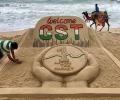
India's Goods and Services Tax (GST) collection surged to Rs 1.30 lakh crore in October, the second highest since its implementation in July 2017, indicating economic recovery from the COVID-19 pandemic and impact of festive demand, a finance ministry statement said on Monday. The highest GST collection of Rs 1.41 lakh crore was recorded in April 2021. This is the fourth time in a row when the GST collection was upwards of Rs 1 lakh crore. The collection from GST was Rs 1.17 lakh crore in September, 2021.

Simpler GST structure will be key poll plank, Congress sources tell Archis Mohan.

The Council also discussed process to make return filing simpler with just one return to be filed every month.

'GST will increase the volume of taxation, there is no tax on tax and therefore makes goods, commodities and services little cheaper and far more convenient.'

Tax experts said historically in July and August indirect tax collections remain subdued and pick up with the onset of the festive season post Ganesh Chaturthi.

If the government tries to bring in real estate under GST now, it will be a typical case of biting more than what one can chew, says Sukumar Mukhopadhyay.

GST rates would depend upon whether the commodity is used by a rich person or a common man

India's gross tax collections soared to a record high of Rs 27.07 lakh crore in the fiscal year ended March 31, led by impressive growth in corporate tax and customs, taking the tax-to-GDP ratio to an over two-decade high of 11.7 per cent, Revenue Secretary Tarun Bajaj said on Friday.

A future road map could be to work towards a single standard rate instead of two standard rates of 12 per cent and 18 per cent, he said.

"To begin with, people could face some difficulties because any changeover has its own problems. But it will settle down and the country will benefit from the new indirect tax regime," Jaitley said at an event organised by ABP News.

The GoM will meet on Saturday to finalise single-stage, simplified, return filing under the GST; report will be placed before GST Council on March 10.
The revenue collection in the same month a year ago stood at Rs 94,442 crore.

Despite a steady collection rate, the government faces a steep Budget target of Rs 6.1 trillion for CGST for 2019-20.

The shift from 'one country, one tax' to four tax rates could dilute possible gains on GDP, warns T N Ninan.

The problem is not GST itself, but the nature of an economy dominated by small businesses unable to cope with the complexities of the tax, points out T N Ninan.
The CAG audit and other data suggests it could be far from the efficient new alternative that was once conceptualised. A conclusive review remains elusive till the government begins to release more granular and comparable data on the complex backend of GST to a deeper scrutiny, by researchers, auditors and the public.
The Centre's revenue from GST registered a decline of 10 per cent in 2017-18 compared to revenue of subsumed taxes in 2016-17.

Tax collection at source would lock in Rs 400 crore of seller money, say Flipkart, Amazon, Snapdeal.

The GST rates for all but six items were finalised at the first day of the two-day meeting of the GST Council, headed by Union Finance Minister Arun Jaitley and comprising state representatives.
Manufacturing taxes, VAT will come down, assures Jaitley

'If my understanding is correct, one has to file not less than 37 returns per year for every ordinary business, and that too per state.' 'If you are doing businesses in Chennai, Bangalore and Hyderabad, you have to file 37x3 returns every year!' 'The consequence of GST will be chaos, confusion and possibly economic crisis.'

The GST bill's draft says tax would be levied on Maximum Retail Price

Some may lose competitiveness due to higher compliance costs

The government has notified mandatory requirement of e-invoicing for B2B transactions for businesses with a turnover over Rs 100 crore with effect from January 1, 2021. Under Goods and Services Tax (GST) law, e-invoicing for business-to-business (B2B) transactions is mandatory for companies with turnover of over Rs 500 crore from October 1. In a notification, the Central Board of Indirect Taxes and Customs (CBIC) said e-invoicing will be extended to businesses with a turnover over Rs 100 crore from January 1.

Reform ideas do not occur overnight and evolve over the years.

Construction costs would be reduced to some extent and this benefit can be passed on to the customers, thereby spurring home buying

Macroeconomic data announcements, global trends and trading activity of foreign investors would guide momentum in the equity market this week, analysts said. Markets ended a five-week losing streak and gained nearly a per cent last week, helped by a sharp rebound on Friday. Last week, the BSE benchmark jumped 500.65 points or 0.77 per cent and the Nifty gained 169.5 points or 0.87 per cent.

The marathon raids against Boudh Distillery Private Limited, its promoters and others entered the fifth day on Sunday.

Its officers would wear black bands on Monday, which is also Martyrs day, the IRS Association (Customs and Central Excise) has said.

'For the first month, we have only had 5.5 million who have paid the tax.' '40 per cent have paid nil as tax; 95 per cent of the taxation for the first two months has come from only 400,000 assessees.' 'So even now, the tax-paying habit, of paying a marginal or negligible amount, or not paying anything at all, is quite prevalent,' reveals Finance Minister Arun Jaitley.
 © 2026 Rediff.com - Advertise with us - Disclaimer - Privacy Policy - Sitemap - Feedback - About us - Terms of use - Grievances